In industrial woodworking environments, operational flexibility and clamping stability are key factors for maintaining tolerances, production flow and finishing quality.
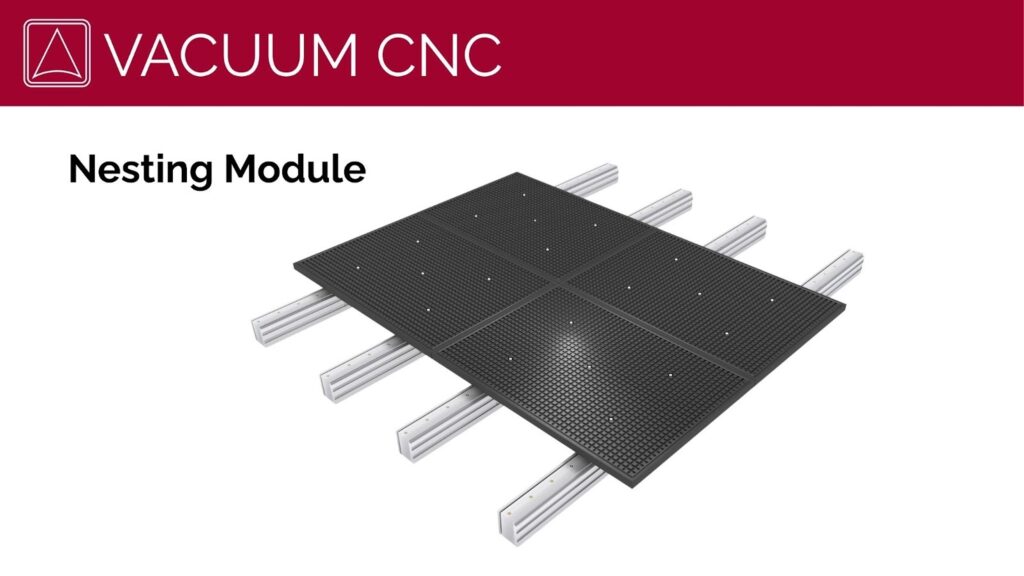
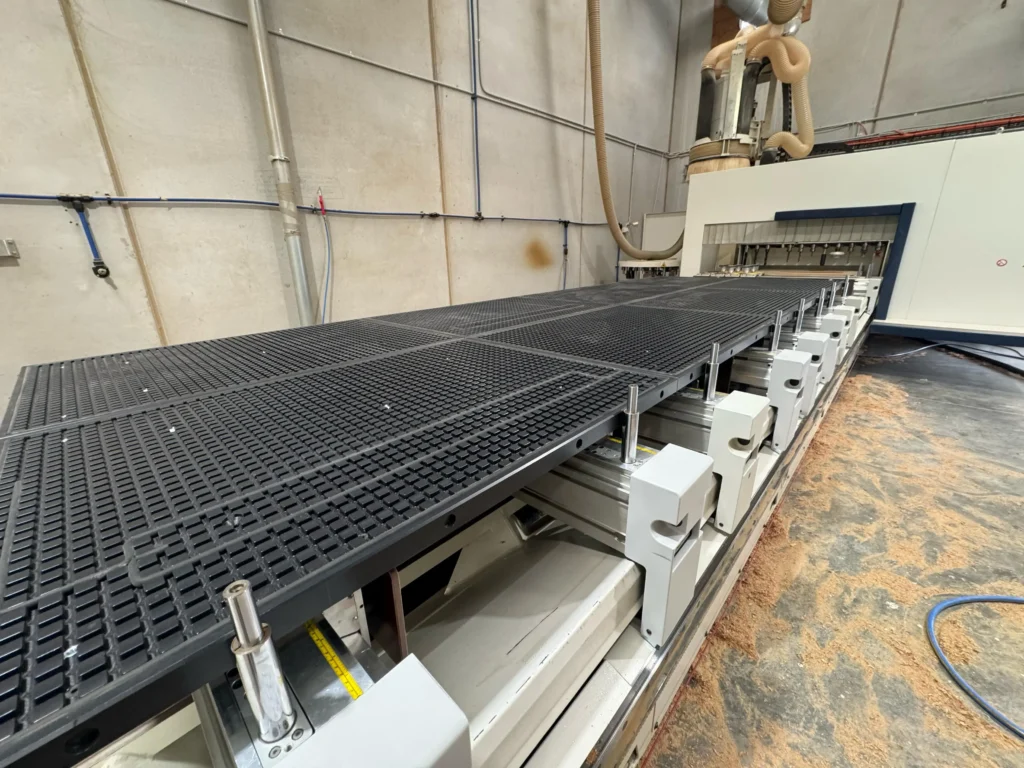
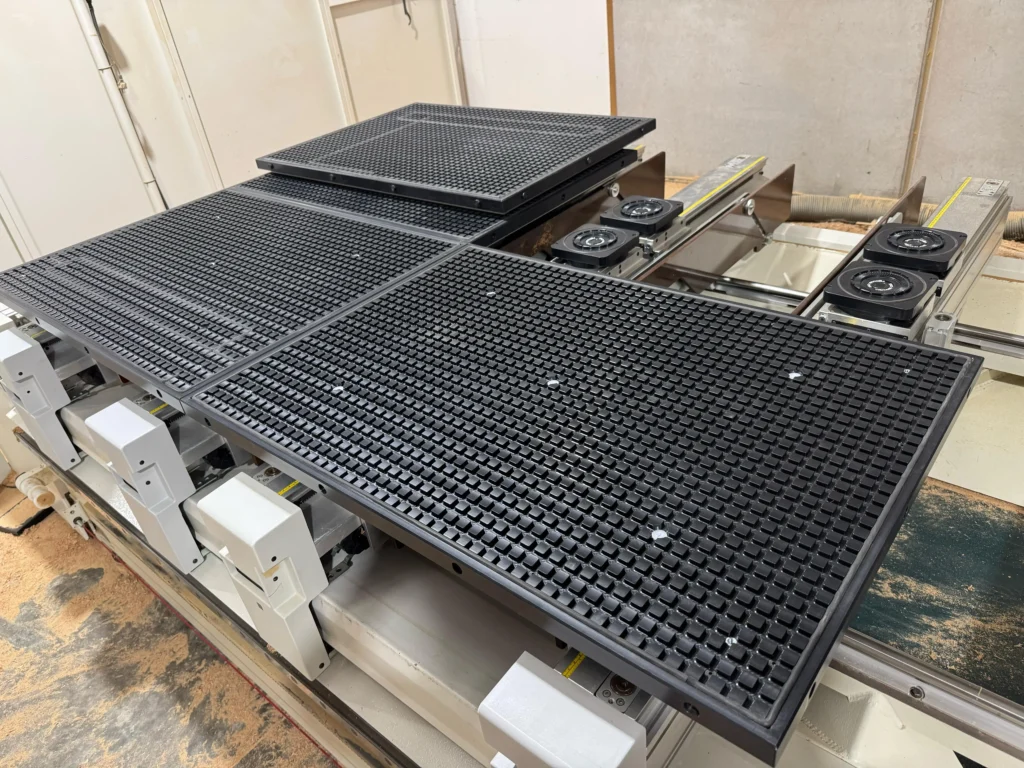
The Vacuum CNC Nesting Module allows workshops to convert a pod & rail CNC machine into a nesting table without modifying the machine, expanding capabilities without interrupting production.
What are nesting tables in industrial CNC machining?
Nesting tables are flat working surfaces designed for machining full boards, where clamping is achieved through distributed vacuum across the entire surface. This system enables continuous routing, internal cuts and multiple machining operations without repositioning parts.
Unlike pod & rail systems, where clamping occurs at specific points using vacuum cups, nesting tables are designed for:
- Full-board machining
- High-volume production of flat components
- Cutting, grooving and routing in a single operation
A common issue with traditional nesting tables is loss of precision caused by spoilboard warping, material porosity or vacuum leaks in machined areas.
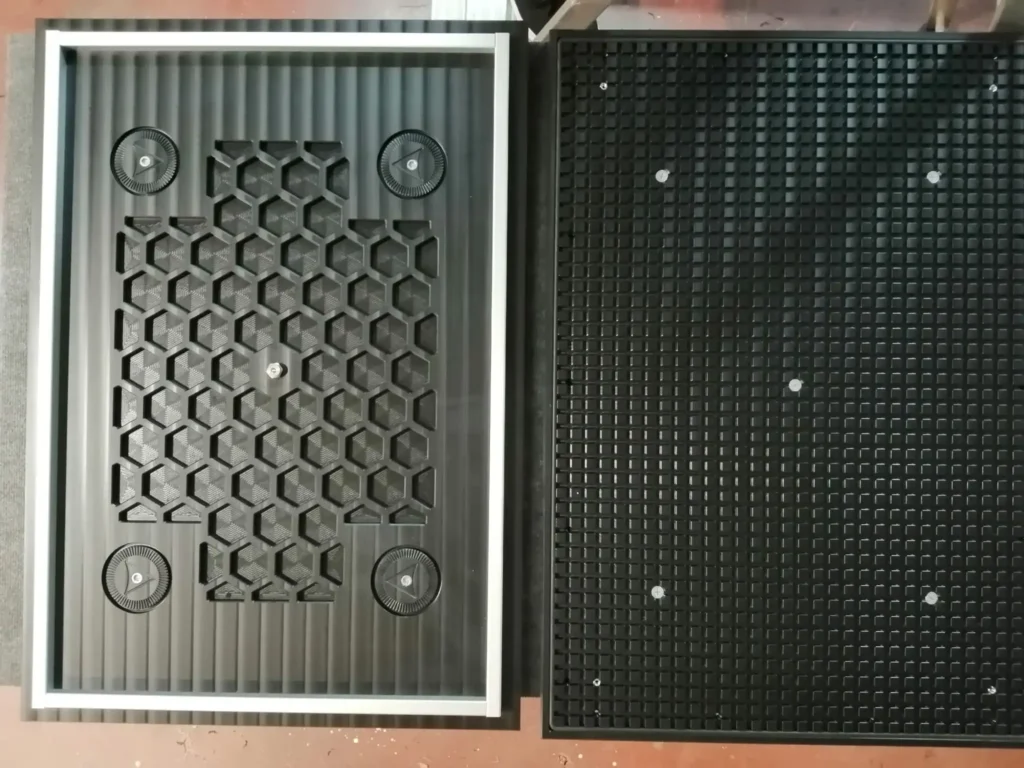
The Vacuum CNC Nesting Module addresses these limitations by fixing the spoilboard directly to the module structure:
- Reinforced aluminium structure
- Threaded interface with Vacuum CNC bases
- Mechanical fixation of the spoilboard
- Reduced deflection between rails
This configuration maintains flatness, reduces vibration, improves repeatability and prevents vacuum losses caused by deformation.
What are the technical characteristics of the Vacuum CNC Nesting Module?
The system is designed to provide structural stability and easy integration in industrial environments where flat machining requires both speed and consistency.
Dimensions
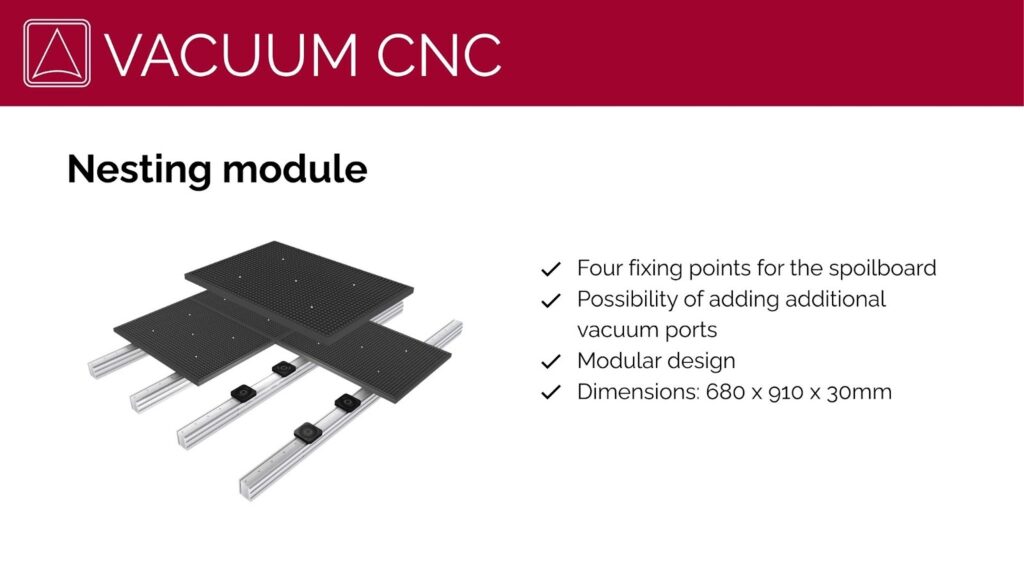
- Size: 680 × 910 × 30 mm
- Activation system: vacuum-based
- Machine integration: direct, no external installation required
Technical features
- Reinforced aluminium structure
- Four fixing points for the spoilboard to maintain flatness and ensure performance
- Threaded system for spoilboard fixation
- Possibility of adding additional vacuum ports
Typical applications of the Vacuum CNC Nesting Module
- Large and thin panels where full-surface vacuum improves stabilit
- Parts with high drilling density, where vacuum losses are critical
- Flat components requiring continuous machining without repositioning
- Furniture and technical panel production
- Industrial woodworking and interior applications
What makes the Vacuum CNC Nesting Module different from a conventional table?
The Vacuum CNC Nesting Module is not a fixed table integrated into the machine, but a modular system that allows a pod & rail CNC machine to be converted into a functional nesting table.
The system is installed directly on Vacuum CNC bases, with no structural modifications required. Switching between pod & rail configuration and nesting is done simply by placing or removing the modules.
How does the conversion process work?
- Install Vacuum CNC bases on the machine
- Place the Nesting Module on the bases
- Connect to the vacuum system
- Fix the spoilboard
No mechanical modifications or structural adjustments are required, avoiding production downtime. This allows a single CNC machine to operate both as a pod & rail system and as a nesting table.
Additionally, the modular design also enables expansion or reduction of working surface and a configuration tailored to each production need. Each nesting module works as an independent unit that can integrate with any machine.
Benefits of modular design for nesting modules:
- Adaptation to different board sizes
- Increased usable working area
- Flexible configurations for different jobs
- Improved setup efficiency and precision
How does vacuum behave in nesting machining?
In conventional nesting processes, drilling multiple holes progressively reduces vacuum, affecting part stability. The Vacuum CNC Nesting Module maintains consistent clamping even under intensive machining conditions.
Stability factors
- Uniform vacuum distribution
- Possibility of additional vacuum ports
- Structural fixation of the spoilboard.
This results in consistent machining across the entire board with reduced risk of part movement and greater stability in long production runs
Nesting systems require higher vacuum flow than standard cup-based systems, especially when working with multiple modules or perforated boards. In most cases, standard machine vacuum capacity is insufficient. For this reason, an additional vacuum pump is recommended, particularly when using more than two modules. This reinforcement is simple to install, cost-effective and fully compatible with existing systems.
What are the operational limitations of nesting tables?
Although nesting provides clear advantages in flat machining, it also has limitations:
- Higher vacuum demand (additional pump required for larger setups)
- Reduced precision in edge machining
- Profiling is more efficient on pod & rail systems
For this reason, combining pod & rail and nesting configurations allows workshops to maximise machine performance.
Why implement a Vacuum CNC Nesting Module in your workshop?
The Vacuum CNC Nesting Module transforms a pod & rail CNC machine into a functional nesting system without modifying the machine.
It provides versatility in production, structural stability and fast configuration changes. Its modular design, structural spoilboard fixation and scalable vacuum system make it a practical solution for flat machining operations in industrial environments.
You can explore this and other CNC workholding solutions here.