


In furniture manufacturing, CNC downtime rarely comes from machine failure.
More often, it comes from setup rigidity.
Time is lost adjusting vacuum pods, forcing standard positions, changing heights with tools, or preparing the machine long before production can actually start. These delays accumulate silently, affecting productivity, flexibility and overall efficiency.
Reducing downtime in CNC woodworking is not about running the machine faster. It’s about removing the steps that slow production down before machining even begins.
What causes CNC downtime in furniture production?
CNC downtime in furniture production is mainly driven by setup rigidity, not by machine performance. In woodworking workshops, long setup times, fixed vacuum configurations and tool-based adjustments slow production down before machining even begins.
Most CNC downtime appears when:
- vacuum pods have fixed heights and suction areas
- pods do not rotate, or rotation requires tools
- parts must be forced into standard positions
- machines need to be prepared hours in advance
Standard OEM vacuum systems are typically designed with fixed configurations. They rarely rotate, and when rotation is available, it often requires disassembling the pod and repositioning it in predefined angles that may not match the actual geometry of the part.
This lack of flexibility forces operators to adapt the job to the system rather than the system to the job. As a result, operators are forced to:
- clamp parts in non-optimal positions
- accept reduced stability
- slow down machining parameters
- or invest extra time compensating for system limitations
The impact of this rigidity becomes critical when setups change frequently, as is common in furniture manufacturing. A single adjustment may seem insignificant, but repetition is the real issue. A 5-minute adjustment on every setup can easily add up to several hours of lost production per week.
In short, CNC downtime in furniture production is not caused by the machine itself, but by workholding systems that limit flexibility, increase preparation time and delay production even when the CNC is technically ready to work.
Vacuum CNC: A modular approach to eliminate setup delays
Vacuum CNC systems are designed around a different principle: the workholding system must adapt to the job, not the other way around.
This principle is implemented through a fully modular architecture based on a base + interchangeable cup design. Instead of replacing or reconfiguring the entire vacuum pod, operators change only the component that is needed for each job.
This modular design allows multiple height configurations, different suction surfaces and full compatibility across the entire Vacuum CNC product range. All components are designed to work together, meaning bases and cups can be freely combined and adapted to each specific machining requirement.
Modular vacuum systems reduce downtime by enabling instant, tool-free changes directly on the CNC table.
Thanks to this modularity, operators can:
- adapt quickly to different part heights
- change suction surfaces easily depending on the material or geometry
- replace damaged or worn cups immediately
- reuse the same bases across multiple configurations
Instead of stopping production to reconfigure the system, adjustments are made in seconds.
How are Vacuum CNC systems installed and changed?
Vacuum CNC systems are installed directly on the CNC table using the machine’s own vacuum. No additional installations, no external systems and no mechanical preparation are required.
Because the system relies entirely on the CNC vacuum, operators can make changes exactly when they are needed, without stopping production or preparing the machine in advance. Setups can be adjusted on the spot, allowing workshops to react immediately to changing production requirements.
Instead of replacing or reconfiguring the entire vacuum pod, operators change only what is necessary. Height and suction surface adjustments are made by swapping the suction cup, not the whole pod.
With Vacuum CNC systems:
- no screws need to be loosened
- no tools are required
- no machine preparation is needed
This approach is especially useful when machining:
- doors and frames
- furniture parts with different thicknesses
- mouldings and decorative elements
Instead of stopping production to reconfigure the CNC table, operators adapt the setup instantly. The result is a more flexible workflow, higher machine utilisation and significantly reduced downtime across the entire production process.
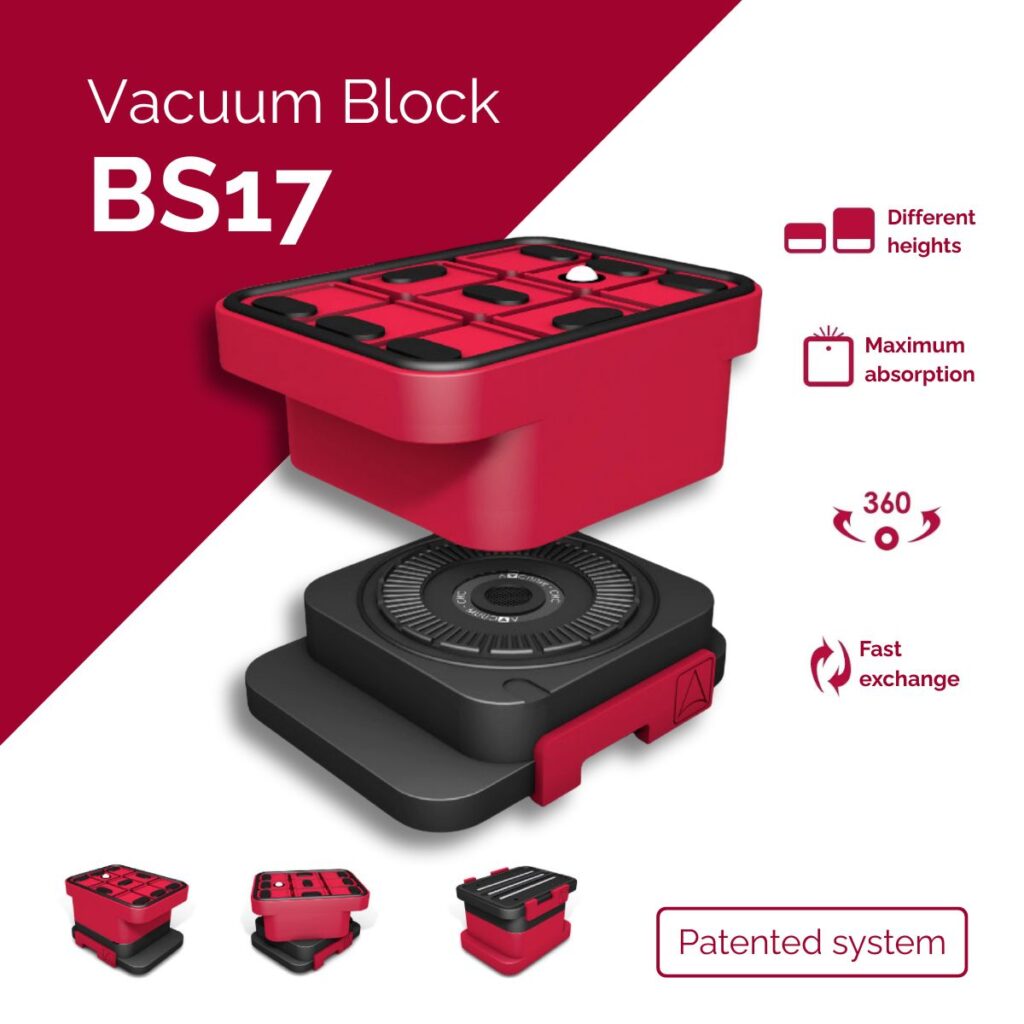
Why do 360° rotation and automatic locking matter in CNC workholding?
Rotation allows parts to be clamped exactly according to their geometry, instead of forcing them into standard positions. When vacuum pods do not rotate, or only rotate in predefined angles, operators are forced to compromise the setup.
360° rotation is not a convenience feature in CNC workholding. It is a requirement for precision, stability and safety.
Without proper rotation:
- parts are clamped in non-optimal positions
- stability is reduced
- vibration increases
- the risk of tool contact with the pod rises
In many standard systems, rotation is either not available or requires loosening and tightening screws. Even when rotation exists, it is often limited which may not match the real geometry of the part. This forces operators to adapt the job to the system instead of adapting the system to the job.
Vacuum CNC pods eliminate these limitations by offering free 360° rotation directly on the CNC table, without screws and without tools. This allows operators to:
- adjust positioning instantly during setup
- avoid repeated mechanical operations
- remove unnecessary setup delays
Once positioned, the Vacuum CNC pod locks automatically at the chosen angle. This automatic locking keeps the pod fixed exactly where it is placed, preventing micro-movements and vibration during machining. Stability is maintained even at non-standard angles, without the need for re-tightening or constant checks,
Thanks to Vacuum CNC’s combination of tool-free rotation and automatic locking, operators can position parts precisely and work with confidence. When different workholding solutions are needed within the same machining process, systems can be exchanged quickly using the same vacuum-based interface, allowing workshops to:
- switch operations faster
- adapt to complex or non-standard parts
- reduce preparation time between jobs
- keep the CNC productive instead of stopped
Reducing downtime is about removing constraints
The cumulative effect is clear:
- no advance preparation hours
- no forced standard positions
- no repeated disassembly
- no unnecessary downtime
By eliminating rigid setups and tool-based adjustments, Vacuum CNC systems allow workshops to react immediately to production needs.
Downtime is reduced because the system removes entire steps, not because operators work faster.
At Vacuum CNC we specialise in workholding systems designed for real production conditions. We care about flexibility, fast setup changes and stability where it actually matters: on the CNC table. Not to make machines faster, but to remove what slows them down.
Frequently Asked Questions (FAQ)
How can I reduce CNC downtime in a woodworking shop?
Focus on setup efficiency. Use modular, tool-free workholding systems that allow instant height, surface and position changes without stopping production.
Why do standard vacuum pods slow down production?
They are usually fixed-height, non-rotating or require tools for adjustment, forcing operators to adapt the process and increasing setup time.
Are Vacuum CNC cups compatible with different CNC machines?
Yes. Vacuum CNC systems are designed to be compatible with major CNC brands and fully interchangeable within the system.
Can I change vacuum cup height during the same production run?
Yes. With Vacuum CNC modular suction cups, height changes take seconds and do not require machine preparation or disassembly.
Is CNC downtime mainly a machine issue?
No. In most furniture workshops, downtime is caused by rigid setups and slow adjustments, not by machine performance.