


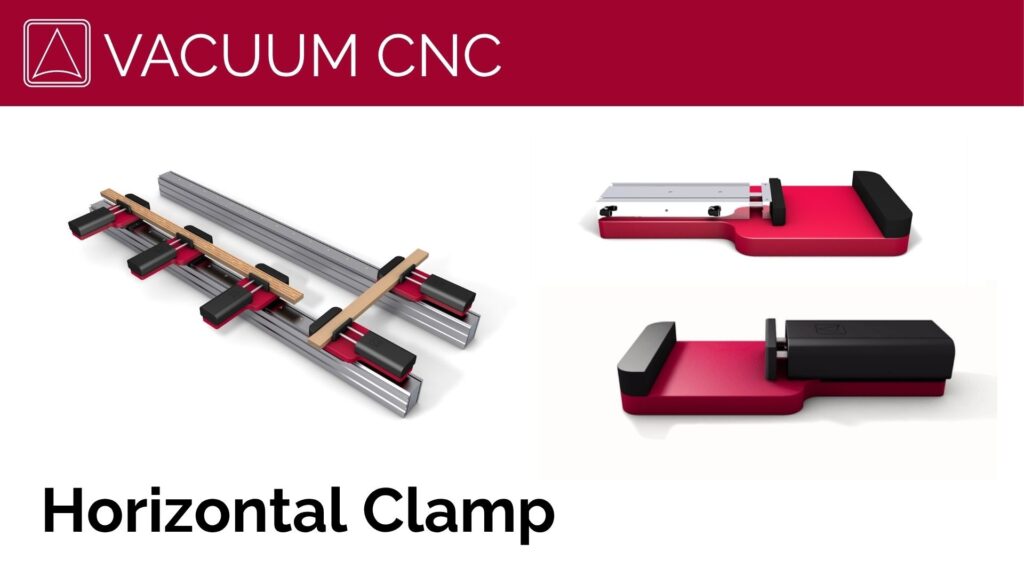
In CNC machining processes, workpiece stability is a critical factor for ensuring precision, repeatability, and operational safety. When working with narrow profiles, battens, elongated pieces, or complex geometries, traditional clamping systems can create limitations in both accessibility and stability during machining.
Horizontal clamps are a highly versatile solution for cutting, profiling, drilling, and sanding operations on CNC machines. Their design applies stable lateral pressure without interfering with the top face of the workpiece, enabling machining operations where the surface must remain completely clear.
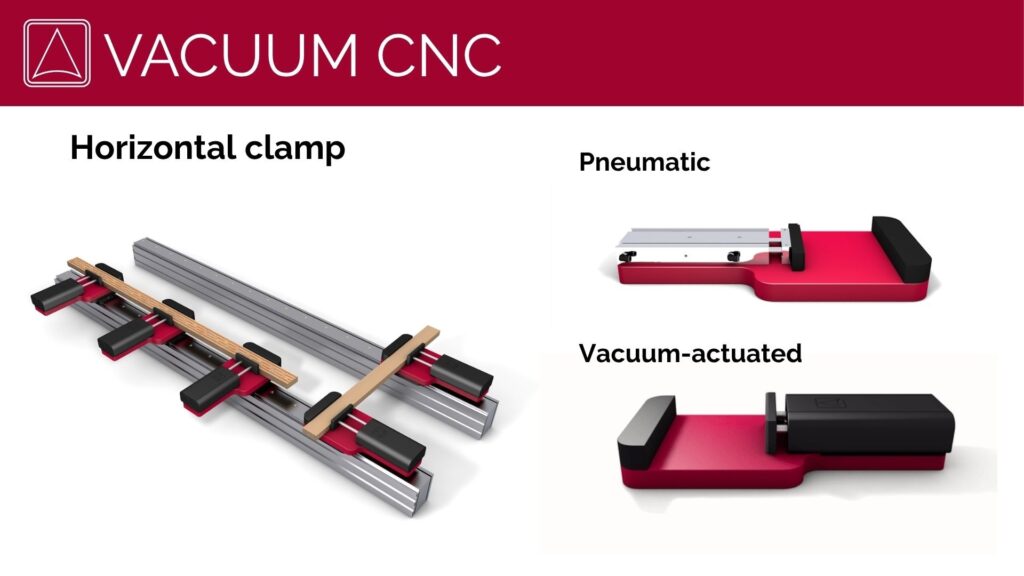
Two main variants are available: the horizontal clamp activated by the machine’s own vacuum, and the pneumatically activated model. Both systems mount on Vacuum CNC bases, making them compatible with virtually any CNC cutting, profiling, or drilling machine.
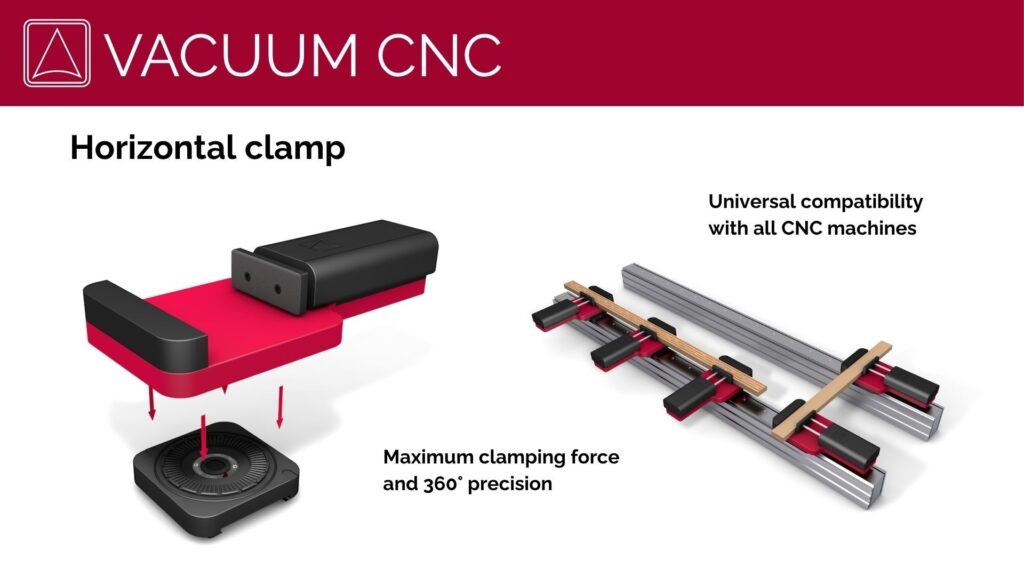
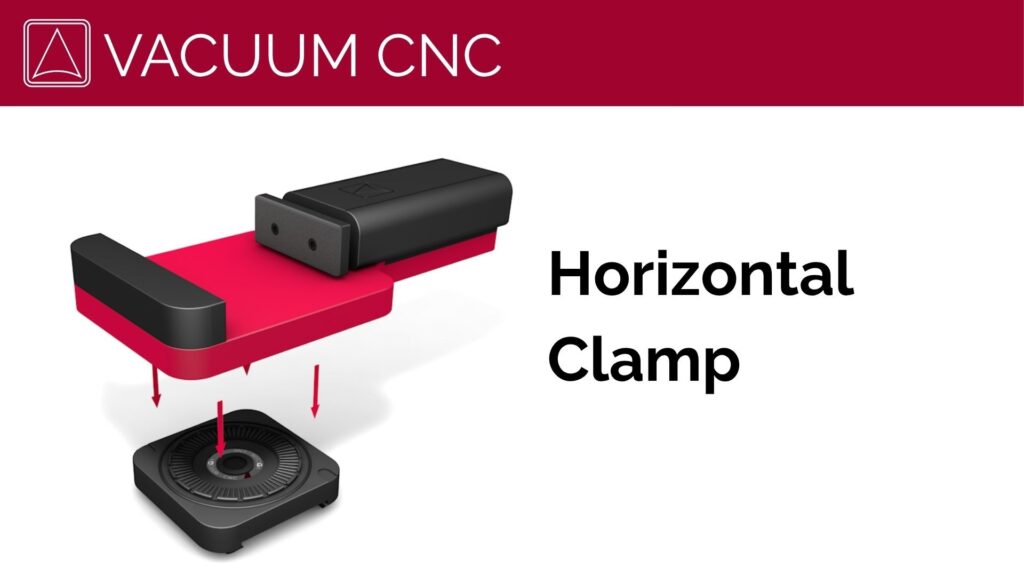
One of the most practical aspects of the system is its modularity. Thanks to the bases designed by Vacuum CNC, the operator can quickly swap a suction cup for a horizontal clamp with a single, effortless movement, therefore significantly increasing production flexibility and reducing setup times.
How does a vacuum- or pneumatically-activated horizontal clamp work?
The horizontal clamp works by applying a constant lateral force to the workpiece to hold it in place during machining. Unlike vertical clamping systems, the pressure is applied horizontally, leaving the top surface of the material completely clear.
This is especially useful for operations such as:
- Decorative grille and border machining.
- Decorative milling.
- Surface milling.
- Friezes and cornices.
- Engravings and carvings.
- Complex profiling.
The system mounts directly on the bases of different CNC machines and features 360° rotation, allowing the clamp to be oriented according to the machining requirements and workpiece geometry. Its design is specifically aimed at small and medium-sized profiles, where stability and free access to the top surface are essential.
In the vacuum-activated model, the piston acts directly using the vacuum generated by the CNC machine itself. This eliminates the need for additional pneumatic installations, greatly simplifying integration.
The pneumatic model uses compressed air to drive the gripping system. A particularly practical option is to add a T-connector to use the air from the machine’s own pneumatic pistons, optimising the installation and reducing additional components.
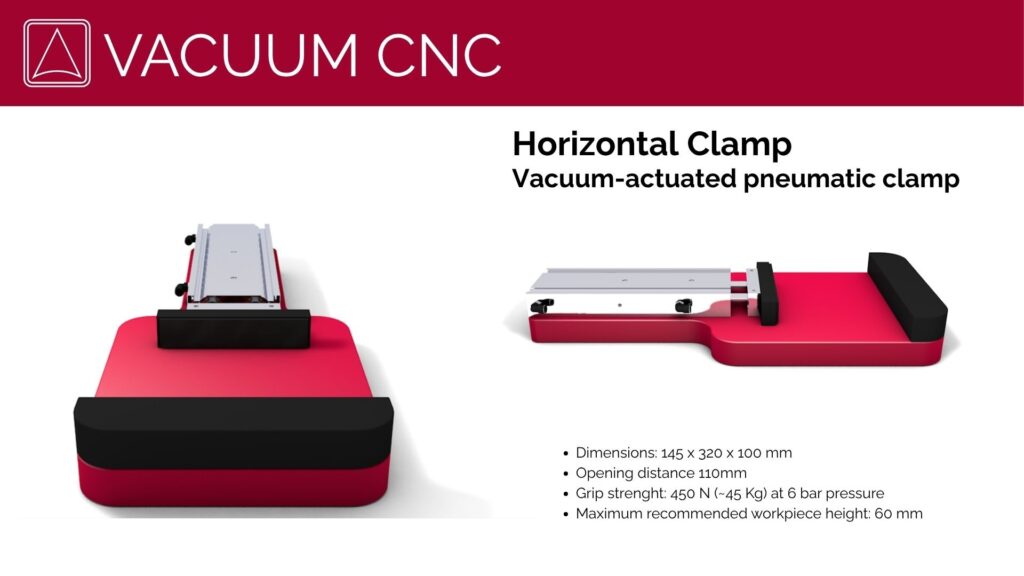
Technical specifications: pneumatically activated horizontal clamp
The pneumatic PH01N model is designed for applications requiring higher gripping force and wider opening travel.
Main technical data: pneumatically activated horizontal clamp
- Overall dimensions: 145 x 320 mm.
- Height: 20 mm (customisable to client requirements).
- Gripping force: 450 N (~45 kg) at 6 bar.
- Opening distance: 110 mm.
- Stroke: up to 150 mm.
- Maximum recommended workpiece height: 60 mm.
- Pneumatic elbows for 6 mm hose.
- Compatible with all CNC machine types.
The high clamping force makes this system a particularly strong option for workpieces subjected to greater lateral stress during intensive machining operations. The adjustable height option also facilitates integration into specific machine or production configurations.
Technical specifications: vacuum-activated horizontal clamp
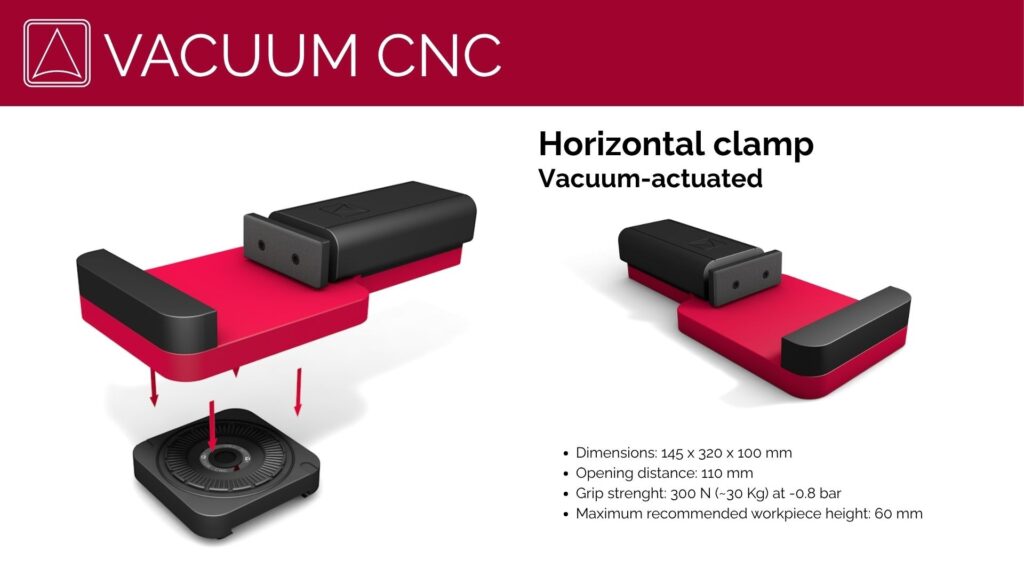
The vacuum-activated PH02V model stands out for its simple installation and direct integration with the CNC machine’s vacuum system.
Main technical data: vacuum-activated horizontal clamp
- Overall dimensions: 145 x 320 mm.
- Height: 30 mm.
- Gripping force: 300 N (~30 kg) at −0.8 bar.
- Opening distance: 100 mm.
- Maximum recommended workpiece height: 60 mm.
By using the machine’s own vacuum directly, this system eliminates the need for external pneumatic installations, reducing assembly and maintenance times.
It is a highly efficient solution for workshops or production lines looking for fast adaptation and operational simplicity without sacrificing stable clamping.
What are the advantages of using horizontal clamps on Vacuum CNC bases?
Integration on Vacuum CNC bases is one of the most important elements of the system. These bases allow the clamps to be adapted to different types of CNC machines regardless of their configuration, providing great operational flexibility within the workshop or production line.
Switching between suction cups and clamps is quick and effortless, allowing the machine to be configured for the task at hand without complex modifications or lengthy setup times. Key advantages of the system include:
Greater machining versatility
The combination of modular bases and horizontal clamps makes it possible to work on pieces that would normally be difficult to fix using traditional systems.
Top surface completely clear
By applying pressure laterally, the operator retains full access to the top face of the workpiece for:
- Decorative milling.
- Engraving.
- Profiling.
- Drilling.
- Surface designs.
Universal compatibility
The system integrates with virtually any CNC machine thanks to Vacuum CNC bases.
Reduced setup times
Fast switching between clamping systems improves operational efficiency and reduces unproductive downtime.
Improved stability and safety
Correct force distribution minimises vibrations and workpiece movement during machining.
Where do horizontal clamps perform best?
Horizontal clamps are particularly suited to workpieces that are difficult to clamp, or materials where other systems have operational limitations.
Most common applications include:
- CNC cutting.
- Profiling.
- Drilling.
- Sanding.
- Decorative milling.
- Grille and frieze manufacturing.
- Batten machining.
- Narrow profile work.
- Elongated pieces.
- Components with complex geometries.
They are also a very efficient solution in processes where the top work surface must remain clear throughout the operation.
Technical recommendations for maximum safety and performance
For maximum stability during machining, it is recommended to use a minimum of two clamps per workpiece. This allows you to:
- Reduce the lever effect.
- Improve load distribution.
- Increase stability.
- Minimise vibrations.
- Increase operational safety.
Workpiece height also matters. Although both systems accept pieces up to the recommended 60 mm height, maintaining balanced configurations significantly improves machining behaviour.
Correct clamp positioning and proper adjustment of clamping forces are essential for ensuring precision and repeatability in high-demand work.
Precision, flexibility, and adaptability for industrial CNC machining
Vacuum- and pneumatically-activated horizontal clamps are a highly specialised solution for CNC operations where stability, free access to the workpiece, and configuration versatility are the priority.
Mounting them on Vacuum CNC bases allows rapid adaptation of the machine to different production processes, simplifying configuration changes and increasing operational efficiency.
Beyond improving clamping on complex or elongated workpieces, these systems help reduce vibrations, improve machining precision, and optimise safety during operation.
With solutions designed specifically for real industrial needs, Vacuum CNC is the specialist technical partner for vacuum, clamping, and stability systems in the high-precision CNC machining industry.